
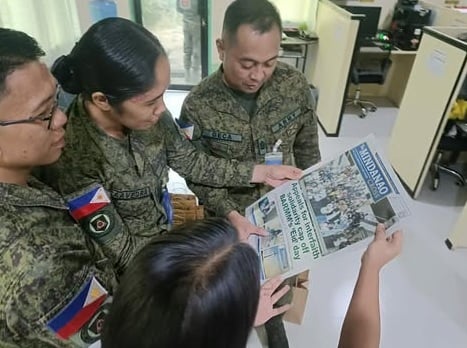
COTABATO CITY (June 10, 2026) —Moro readers were elated learning that the non-profit Catholic tabloid circulating in Central Mindanao, promoting since the 1940s interfaith solidarity among Muslim, Christian and indigenous communities, was cited as the country’s best edited community newspaper by the Philippine Press Institute (PPI) on Thursday, June 4.
The Panay News, also a community paper in the Visayas, also received the same award from the PPI, radio reports in Cotabato City on Tuesday stated.
The Mindanao Cross, owned by the Oblates of Mary Immaculate (OMI) congregation, which circulates every Friday here and in nearby towns in the Bangsamoro Autonomous Region in Muslim Mindanao and in Administrative Region 12, is touted as the country’s longest-running community newspaper, being published weekly since 1948.
The OMI congregation, whose main pontifical base is in the Vatican City in Rome, has missionary and humanitarian activities, since the 1930s, here and in what are now large provinces in Central Mindanao, in Sulu in Region 9 and in Tawi-Tawi in the Bangsamoro Autonomous Region in Muslim Mindanao.
Drema Quitayen-Bravo, manager of the also so old Station DXMS in this city, also owned by the OMI congregation, personally received the PPI’s best edited community newspaper citation for Mindanao Cross during a symbolic rite on Thursday last week at the Hotel Lucky Chinatown in Binondo, Manila.
“We are happy with that recognition that the Mindanao Cross got from the Philippine Press Institute. We have been seeing for so many years now how it has been struggling to propagate ecumenism and the need for unity among Christians and Muslims in community peace and development initiatives,” said BARMM’s health minister, the physician-ophthalmologist Kadil Sinolinding Jr., a Muslim Maguindanaon.
Sinolinding, also a member of the 80-seat BARMM parliament, and his two colleagues in the regional lawmaking body, Ishak Mastura and Zulfikar-Ali Bayam, both Moro datus, separately told reporters on Tuesday that the Mindanao Cross deserved the PPI award owing to its being so careful in the composition of its reports, presented via conflict-sensitive wordings as part of its editorial board’s peacebuilding goals.
“The reports of Mindanao Cross are well edited and have good insights educating readers that peace and unity among the local culturally-divergent communities is very important,” Mastura said.
Mastura’s patriarch, the lawyer Michael Mastura, who had served as congressional representative of the still undivided Maguindanao in the 1990s and had supported the government’s peace overture with the Moro Islamic Liberation Front that resulted in the creation in 2019 of the BARMM government, was a former columnist of the Mindanao Cross.
Bayam said elders of their clan in Kabuntalan, Maguindanao del Norte and in Cotabato City are readers of the Mindanao Cross since he was still a primary school pupil.
The non-stock and non-profit Mindanao Cross was established after World War 2 by foreign and Filipino OMI priests in Cotabato City, led by their figurehead in the city then, the French-Canadian Oblate missionary Gerard Mongeau. Its first issue came out on February 6, 1948, produced by a printing press in Cotabato City.
The military and police stopped its publication for a period after the country was placed under martial law in 1972 by President Ferdinand Marcos, Sr. for its tough stance on his intolerance of political opposition. The Mindanao Cross was permitted to resume weekly publication only after its publisher signed a written commitment not to publish articles opposing the military rule in the country then.
An ethnic non-Moro Teduray member of the BARMM parliament, Ramon Piang, Sr., former mayor of the predominantly Teduray upland Upi town in Maguindanao del Norte, said he is grateful to the Mindanao Cross for its continuing focus on the need to preserve their culture and tradition as an indigenous community in Central Mindanao and on how they are struggling to foster peace and sustainable development in their state-recognized ancestral domains.
“For that, we are grateful,” Piang said. []